Embroidery Digitizing Cost in 2026: Flat Rates, Per-Stitch Prices and What You Actually Pay
Real 2026 digitizing prices: $10-$30 for a chest or cap logo, $30-$100 for a jacket back, $1-$3 per 1,000 stitches. See a provider price table, a worked example and the fees that catch shops out.
Embroidery Digitizing Studio
Commercial Digitizing Service
Need production-ready machine files? Explore our Embroidery Digitizing Services
Embroidery digitizing costs $10 to $30 for a standard left chest or cap logo and $30 to $100 for a large jacket back in 2026. Providers that bill by stitch count charge about $1 to $3 per 1,000 stitches, usually with a minimum charge. Velora Digitizing uses three flat plans instead: $6.99 for designs up to 5,000 stitches, $12.99 up to 15,000 stitches and $19.99 for unlimited stitches with rush delivery. The full plan breakdown is on our embroidery digitizing pricing page.
This guide covers the fee to create the stitch file. That is separate from the production charge to sew the design onto each garment, which is also often quoted per 1,000 stitches and causes most of the confusion around this topic. Below you will find a price table from nine providers, a worked example at 7,000 stitches, the fees that appear after the quote, and a short list of ways to pay less without buying a bad file.
Embroidery Digitizing Prices in 2026: What Providers Publish
The ranges above are not a guess. They come from prices that digitizing companies publish on their own pricing pages. The table shows the figures as listed in November 2026 so you can see how flat-rate and per-stitch providers compare for the same job.
| Provider | Pricing model | Left chest / cap logo | Jacket back / large design | Notes |
|---|---|---|---|---|
| Velora Digitizing | Flat, by stitch count tier | $6.99 (up to 5,000 stitches) | $12.99 (up to 15,000) or $19.99 (unlimited) | All plans include DST, PES, EXP, JEF; revisions per plan |
| 1Dollar Digitizing | Per stitch | $1 per 1,000 stitches, $6 minimum | $1 per 1,000 stitches | Cheapest per-stitch rate found |
| ThreadArt | Per stitch | $4 per 1,000 stitches | $4 per 1,000 stitches | Supplier offering digitizing as an add-on |
| Migdigitizing | Flat from $8, or per stitch | From $8 | $1.50 per 1,000, capped at $90 | Price cap on very large designs |
| EmbroideryDesigns.com | Flat by size | $10-$25 (up to 4 in) | $25-$50 (4-8 in), quote above | Tiered by finished width |
| Impact Digitizing | Flat by size | $10-$25 (small), $20-$45 (medium) | $40-$80+ | Cap digitizing priced separately |
| PRO digitizing | Flat | From $15 | Quote | No stitch-count fees |
| digitizingdelight.com | Flat by size | $20 (small), $35 (medium) | $60 (large) | Pay after approving a preview |
| Qdigitizing | Flat by placement | $25 (anything inside a 6 in circle) | $75 | Simple pricing, higher entry point |
Two things stand out. First, the spread for the same left chest logo is $6.99 to $25, so the provider you choose matters more than the design. Second, almost every provider that quotes a very low per-stitch rate also has a minimum charge, so a tiny design never actually costs $1.
The Two Pricing Models, With a Worked Example
Per 1,000 stitches
The traditional model. The provider multiplies a rate by the finished design's stitch count. Typical 2026 rates are $1 to $3 per 1,000 stitches, with a minimum charge of about $6 to $25 because even a tiny design needs setup, a test and file export.
Flat rate per design
One fixed price per design, sometimes tiered by finished size or by stitch-count band. You know the cost before you upload. Small logos typically land at $7 to $30; jacket backs, large applique and detailed artwork at $30 to $100.
Worked example: a 7,000-stitch left chest logo
Take a two-color left chest logo, 3.5 inches wide, with a short line of text. A design like this commonly comes out around 7,000 stitches. Here is what the same file costs under each model, using the published prices above.
| Pricing model | Calculation | Digitizing fee |
|---|---|---|
| Per stitch at $1 per 1,000 | 7 x $1 (above the $6 minimum) | $7.00 |
| Per stitch at $2 per 1,000 | 7 x $2 | $14.00 |
| Per stitch at $4 per 1,000 | 7 x $4 | $28.00 |
| Flat by size, small tier | Up to 4 in wide | $10-$25 |
| Flat by placement | Fits inside a 6 in circle | $25.00 |
| Velora Standard plan | Over 5,000 stitches, under 15,000 | $12.99 |
For a logo this size the models overlap: $7 to $28 depending on the provider, with most clustered between $10 and $15. Per-stitch pricing only pulls ahead on very small text-only designs, and it gets expensive on dense fills. Flat rates win on predictability, which matters when you quote a customer before the file exists.
What Drives the Price Up or Down
- 1Stitch count and finished size. More stitches mean more time to build, sequence and test. A 3-inch logo and a 12-inch jacket back are different jobs even when the artwork is identical.
- 2Artwork detail. Gradients, photographic shading, thin outlines and text under about 4 mm all need manual rebuilding rather than straight conversion.
- 3Number of colors and color changes. Each change adds a trim, a stop and sequencing decisions.
- 4Garment and fabric. Caps, fleece, towels, performance knits and leather need different underlay and pull compensation than a woven polo.
- 5Technique. 3D puff, applique, chenille, metallic thread and patch borders add programming steps (see surcharges below).
- 6Artwork quality. A clean vector file is faster to digitize than a blurry screenshot that has to be redrawn first.
- 7Turnaround. Rush delivery usually carries a premium. Velora's Rush plan at $19.99 is the only one of our plans with a 2-4 hour window; Standard is 12-24 hours and Basic is 24-48 hours.
It Is a One-Time Fee: You Own the File
Digitizing is a one-time setup charge per design. Once the stitch file is delivered you keep it, reuse it on every repeat order and send it to any embroiderer you like. You should not pay a digitizing fee again for the same logo at the same size, whether you order from the same shop next month or switch suppliers next year.
Watch for two exceptions. Some embroidery shops bundle a $25 to $50 'setup fee' into the first garment order and keep the file themselves; ask for the DST or PES file in writing before you pay. And a file is made for one size and one fabric, so a new placement or a very different garment is a new file, not a reuse.
Edits, Resizing and Re-Digitizing Charges
- Thread color changes and small text corrections are normally free or covered by the revision allowance.
- Resizing by more than about 10 to 20 percent changes stitch density and underlay behavior. Most providers treat it as re-digitizing and charge again, at or near the original fee.
- Adding a new element (a tagline, a second logo, a border) is new digitizing work and is priced as such.
- Converting a flat file for a cap or for 3D puff is not a format conversion. The stitch sequence has to be rebuilt, so expect a new fee.
- Format exports (DST to PES, for example) should be free. If a provider charges per format, that is a red flag.
Velora's revision policy is tied to the plan: 1 free revision on Basic, 3 on Standard and unlimited on Rush. The plan details are on the pricing page.
Specialty Surcharges: 3D Puff, Applique, Metallic and Patches
| Technique | Extra digitizing work | Typical market effect | Velora |
|---|---|---|---|
| 3D puff | Foam stop, end-capped satin columns, higher density, flat elements sequenced first | Often priced in a higher tier or quoted | Priced by stitch count like any design; most puff caps fall in Standard or Rush |
| Applique | Placement line, fabric stop, tackdown and cover border; optional cut file | Mid tier, sometimes plus a cut-file fee | Priced by stitch count; cut file on request |
| Metallic thread | Lower density, longer stitches, fewer sharp direction changes | Small surcharge or none | No surcharge; tell us the thread when ordering |
| Patches | Merrow or satin border, backing specification, size callouts | Mid tier | Priced by stitch count; physical patch production quoted separately |
If you are deciding between techniques, our guides on 3D puff digitizing and applique digitizing explain what each file contains, and the services overview shows which service fits which placement.
How to Avoid Overpaying
- Know your stitch count before you ask for quotes. It is the only way to compare a per-stitch rate with a flat tier.
- Send vector artwork (AI, EPS, SVG or PDF). Clean paths cut the digitizer's cleanup time and remove the 'artwork redraw' line from some quotes.
- Simplify before you order. Dropping a gradient or merging two near-identical colors reduces both the digitizing fee and every future sewing charge.
- Order all placements at once. If the same logo goes on a polo and a cap, say so up front; some providers discount the second file.
- Ask for the file, in writing. Make sure the DST or PES is delivered to you, not held by the embroiderer.
- Check the revision policy and minimum charge before you pay, not after.
When Cheap Is a False Economy
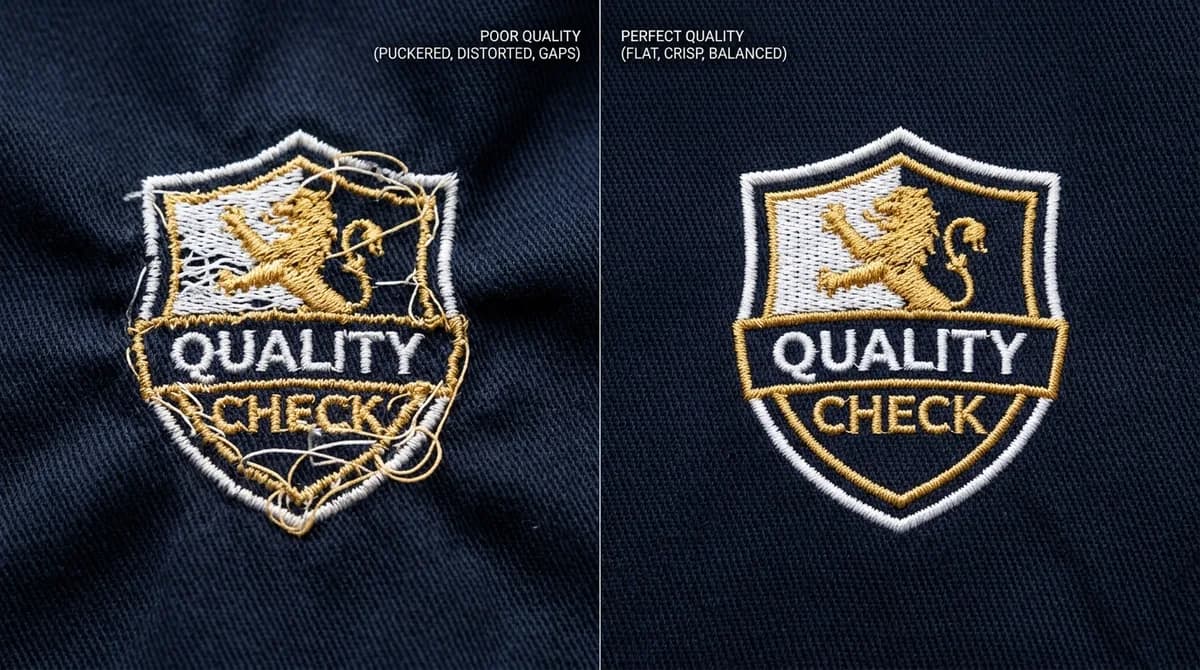
There is a difference between a low flat rate from a manual digitizer and a $1-$3 'complete logo' from an auto-digitizing marketplace listing. The second kind is usually traced by software with no human review. The result tends to show up as thread breaks, puckering on knits and small text that reads as a blur, all of which are covered in our guide to common embroidery digitizing mistakes.
Price the failure, not the file. One ruined run of 50 corporate polos costs more in blanks, thread and machine time than the difference between a $3 file and a $13 one, many times over. The questions that separate the two are simple: is the file digitized manually, is there a revision policy, and will the provider tell you the stitch count before you sew?
Red Flags in a Digitizing Quote
- 1A price far below the published market range with no mention of manual digitizing.
- 2No revision policy, so a small fix becomes a new paid order.
- 3No stated turnaround, which makes production planning guesswork.
- 4One file format only, when your machine may need DST, PES, EXP or JEF.
- 5No stitch count on the quote or delivery, meaning nobody has checked what the file will cost you to sew.
- 6Fees that appear after approval for size changes, color changes or rush delivery.
How to Get an Accurate Quote Fast
- 1Send the best artwork you have: vector AI, EPS, SVG or PDF, or a large clean PNG.
- 2State the finished width and height in inches or millimeters.
- 3Name the garment and fabric: polo, structured cap, fleece hoodie, jacket back, patch.
- 4List any technique: 3D puff, applique, metallic thread, specific thread colors.
- 5Confirm the machine format and the date you need the file.
If your only artwork is a low-resolution screenshot, read how to prepare your logo for embroidery digitizing before you request a quote. Clean artwork is the single cheapest way to lower the price.
Ready for a Clear Price on Your Logo?
Velora Digitizing prices every design by stitch count on three flat plans, with the machine formats and revision allowance listed up front on the pricing page. Browse the digitizing services to pick the right file for your placement, or send your artwork through the contact page for a free quote with the stitch count included.
This guide covers the cost of the stitch file. For the per-piece price of embroidery on shirts, hats and hoodies, see how much does embroidery cost. Starting a shop? See how to start an embroidery business.
Written by the Velora Digitizing Team
Digitizing StudioThis guide is written and reviewed by the digitizers at Velora Digitizing, who prepare embroidery files for caps, jackets, patches, and left chest logos every day. The advice here comes from the same stitch-path, underlay, and fabric choices we make on client orders.
Related service
Embroidery Digitizing Services