Metallic Thread Keeps Breaking on Your Embroidery Machine? Causes, Settings and Fixes
Metallic thread adds shine, but it breaks and shreds easily. Here is why it keeps breaking and the needle, tension, speed and digitizing setup that stops it.

Embroidery Digitizing Studio
Commercial Digitizing Service
Need production-ready machine files? Explore our Custom Embroidery Digitizing
If metallic thread keeps breaking on your embroidery machine, the cause is almost always one of five things: a needle eye that is too small, top tension that is too tight, too much speed, thread twisting as it leaves the spool, or a design that is too dense. Metallic embroidery thread is weaker and stiffer than polyester, so to stitch with it reliably, use a metallic needle (80/12 or 90/14), lower the top tension, slow the machine down, let the thread feed from a stand so it does not twist, and use a design with lighter density and satin columns rather than heavy fills.
This guide covers types of metallic thread, machine settings and how to digitize for it. Our digitizing team can prepare metallic-friendly versions of your logo with adjusted density.
Types of Metallic Thread
| Type | Look | How it runs | Use for |
|---|---|---|---|
| Wrapped metallic | Classic metallic shine | Runs reliably with the right needle and a slower speed | Logos, monograms, crests; the standard choice |
| Flat film (sliver) | The highest sparkle | The hardest to run; twists and breaks easily | Small decorative accents |
| Polyester metallic-look | Bright, with less sparkle | Runs almost like normal polyester | Production runs where breaks are costly |
| Hand embroidery metallic floss | Varies | Not for machines | Hand embroidery only |
- Wrapped metallic: a metallic foil wrapped around a core thread; the most common type for machine embroidery.
- Flat film ("sliver") thread: a thin flat ribbon with high sparkle; beautiful but harder to run.
- Polyester metallic-look: shinier polyester that is easier to stitch, with less sparkle.
- Hand embroidery metallic floss: for hand work; different from machine thread.
Machine Settings for Metallic Thread
| Setting | Normal 40 wt polyester | Metallic thread |
|---|---|---|
| Needle | 75/11 embroidery needle | Metallic or large-eye needle, 80/12 or 90/14 |
| Machine speed | Normal production speed | Slowed down, roughly 500 to 650 stitches per minute as a starting point |
| Top tension | Standard | Lower; adjust on a test sew-out |
| Thread path | Any spool pin | A thread stand, so the thread unwinds without twisting |
| Design density | Standard | Slightly more open |
| Shortest stitches | Around 1 mm is workable | Avoid stitches shorter than about 2 mm |
| Needle changes | On the normal schedule | More often; metallic thread wears the eye |
- Needle: metallic needle or larger eye, 80/12 to 90/14. See the needle size guide.
- Top tension: lower than for polyester; adjust with a test sew-out.
- Speed: slow down noticeably; high speed creates heat and friction.
- Thread path: use a thread stand or vertical spool pin so the thread unwinds without twisting.
- Fresh needle: metallic thread wears needles faster; change more often.
How to Embroider With Metallic Thread: Step by Step
- 1Choose or order a design with lighter density and few stacked layers.
- 2Hoop with a firm stabilizer; see the stabilizer guide.
- 3Install a new metallic needle and thread the machine carefully through every guide.
- 4Lower the top tension and reduce machine speed.
- 5Stitch a test on scrap fabric and check the back for balanced tension.
- 6Run the real piece, watching the metallic color stop closely.
Digitizing Designs for Metallic Thread
- Lower density: metallic thread is thicker and stiffer, so spacing should be wider than standard.
- Prefer satin columns: satin stitches show off the shine and stitch more smoothly than large fills.
- Avoid tiny details: very short stitches shred metallic thread.
- Sequence metallic last: stitching it on top avoids extra friction from later layers.
- Lighter underlay: reduce underlay under metallic areas.
Metallic Thread Keeps Breaking? Troubleshooting Chart
| Problem | Likely cause | Fix |
|---|---|---|
| Thread shreds at the needle | Needle eye too small, or a worn needle | Fit a new metallic or large-eye needle, 80/12 or 90/14 |
| Thread kinks or curls before the needle | It is twisting as it leaves the spool | Feed it from a thread stand so it unwinds straight off the top |
| Breaks every few hundred stitches | Speed too high or top tension too tight | Slow the machine and lower the top tension |
| Breaks in the same spot each time | Dense area, tiny stitches or stacked layers in the file | Open the density and lengthen the stitches there |
| Design feels stiff and wiry | Density set for polyester | Use a version digitized for metallic thread |
| Bobbin thread shows on top | Top tension still too tight for this thread | Lower the top tension a little more and test again |
Best Uses for Metallic Embroidery
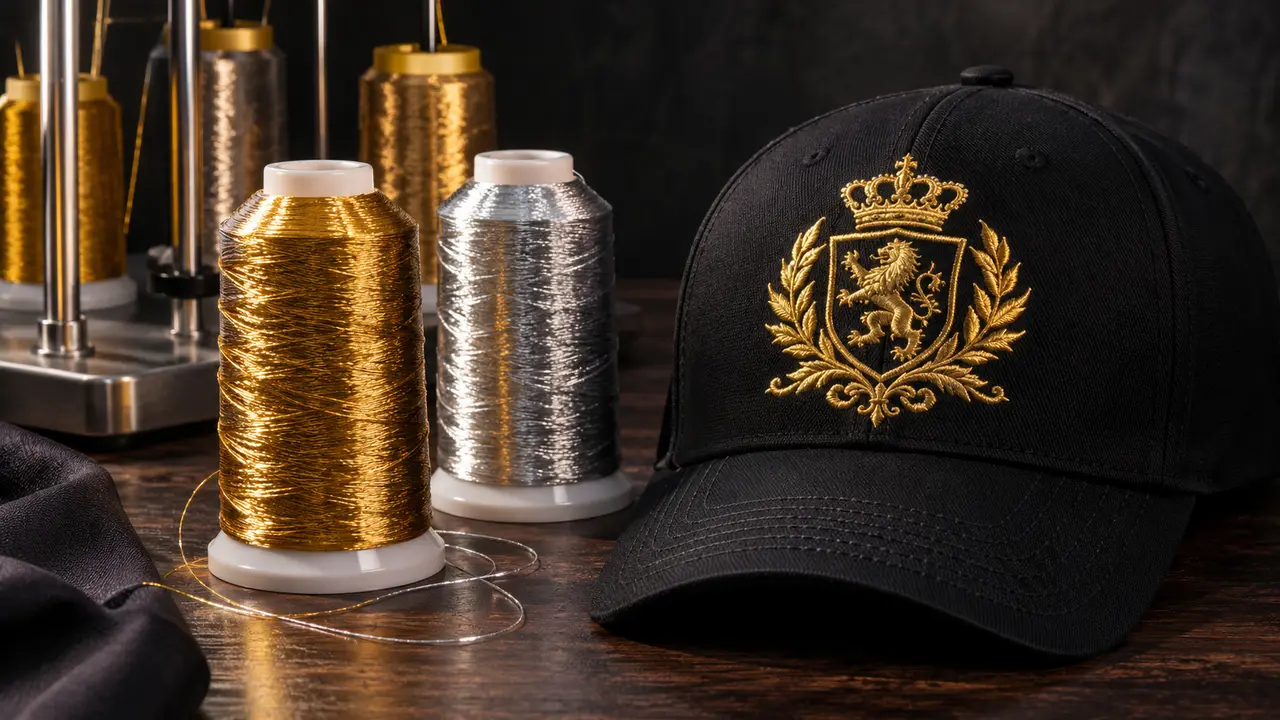
- Accents on caps and luxury logos; see cap logo digitizing.
- Monograms and names on towels and gifts; see best fonts for embroidery.
- Badges, crests and embroidered patches.
- Holiday, wedding and award designs.
Still getting breaks? Read how to fix puckering and thread breaks and the thread weight guide. For a metallic-ready file, send your design or see digitizing prices.
Written by the Velora Digitizing Team
Digitizing StudioThis guide is written and reviewed by the digitizers at Velora Digitizing, who prepare embroidery files for caps, jackets, patches, and left chest logos every day. The advice here comes from the same stitch-path, underlay, and fabric choices we make on client orders.
Related service
Custom Embroidery Digitizing