Embroidery vs Screen Printing: Cost, Durability & Which to Choose for Uniforms
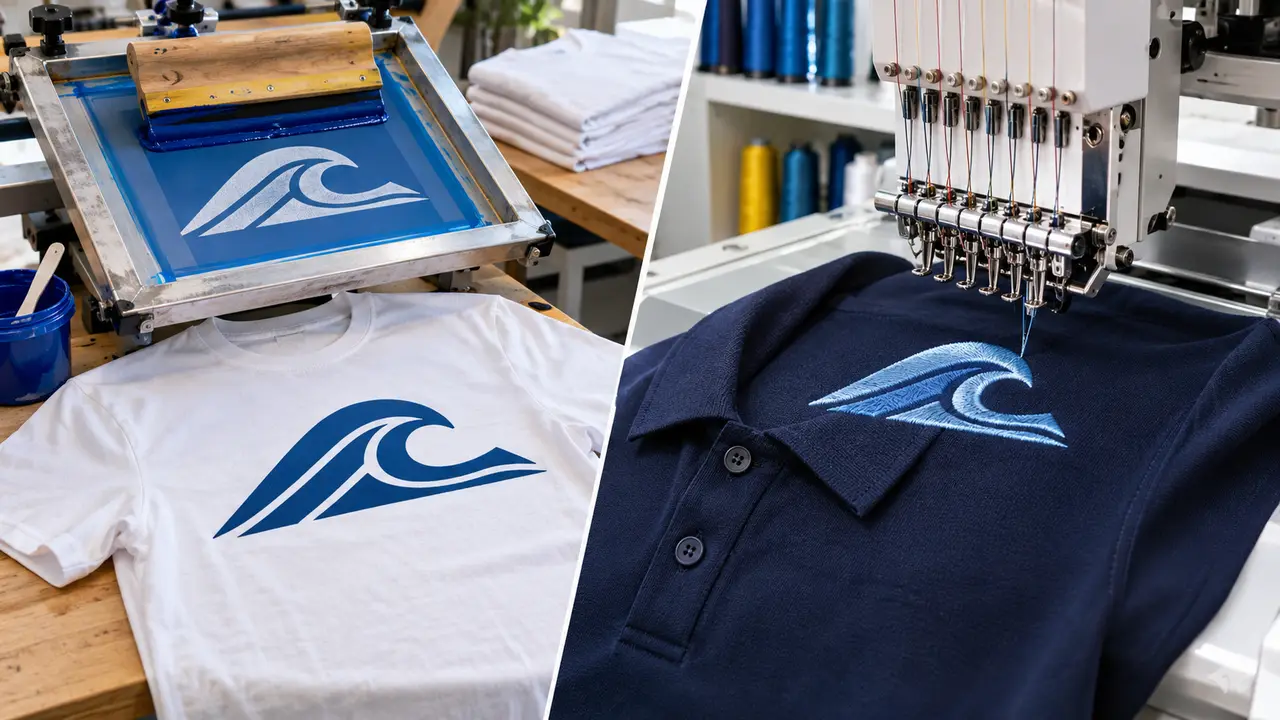
Embroidery costs more per piece on big T-shirt runs but often less on small orders of polos and caps. Here is how the cost changes with quantity, and which method suits work uniforms.
Embroidery Digitizing Studio
Commercial Digitizing Service
Need production-ready machine files? Explore our Embroidery Digitizing Services
Is embroidery more expensive than screen printing? Per piece, usually yes on large T-shirt runs, but often no on small orders. Embroidery has a single, reusable digitizing fee and is then priced by stitch count, so a 12-piece order of polos or caps with a three-color logo can cost less than screen printing, which needs a screen for every color. On 100 or more T-shirts with a simple print, screen printing becomes cheaper. Embroidery also lasts longer, which is why most work uniforms are embroidered.
This guide compares the two methods on cost, durability, garments and design limits so you can choose with confidence. If you choose embroidery, our embroidery digitizing services turn your logo into a production-ready stitch file.
Embroidery vs Screen Printing at a Glance
| Embroidery | Screen printing | |
|---|---|---|
| How it is made | Thread stitched into the fabric by machine | Ink pushed through a mesh screen, one screen per color |
| Look and feel | Raised, textured, premium | Flat and smooth; heavy ink can feel thick |
| Durability | Rarely fades or cracks; survives industrial washing | Durable when cured well; can crack or fade over many washes |
| Setup cost | One digitizing fee per logo, reused on every order | One screen per color, per design |
| Cost as quantity grows | Falls slowly; mostly machine time per piece | Falls quickly once screens are made |
| Detail and color | Bold shapes; text above about 5 mm; no true gradients | Fine lines, halftones and many colors |
| Design size | Best for small and medium logos | Large front and back prints |
| Best garments | Polos, caps, jackets, fleece, bags, workwear | T-shirts and lightweight tops |
Cost: Which Is Cheaper?
Screen printing cost depends mostly on the number of colors and pieces. Each color needs its own screen, so setup is the expensive part, and the price per shirt drops quickly as quantity rises. Embroidery cost depends on stitch count and quantity. There are no screens, only a one-time digitizing fee, and the file can be reused on every future order.
| Order | Usually cheaper | Why |
|---|---|---|
| 12 polos with a 3-color left chest logo | Embroidery | Three screens cost more than one digitizing fee spread over 12 pieces |
| 24 caps with a front logo | Embroidery | Caps are hard to print well; embroidery is the standard |
| 100 T-shirts with a 1-color front print | Screen printing | One screen, fast printing |
| 300 T-shirts with a 4-color full-front graphic | Screen printing | Setup is spread over many pieces; a large embroidered design would be heavy and slow |
| Reorders of the same logo | Embroidery | The digitized file is reused, so there is no new setup |
For a 12-piece order of polos with a three-color logo, embroidery is often the better value. For 300 T-shirts with a full-front graphic, screen printing usually wins. See how much embroidery costs and embroidery digitizing cost for typical price structures.
How the Cost Changes With Quantity
The two methods spread their setup costs differently, which is why the cheaper option flips as the order grows. The table below shows the pattern, not a quote; real prices depend on the shop, the garment and the design.
| Order size | Screen printing | Embroidery | Usually cheaper |
|---|---|---|---|
| 1 to 11 pieces | Screen setup per color is spread over very few pieces; many shops have a minimum | One digitizing fee, then stitch-count pricing | Embroidery |
| 12 to 24 pieces | Setup still a large share of each shirt, more so with 3+ colors | Per-piece price falls slowly with quantity | Close; embroidery often wins on multi-color logos |
| 48 to 100 pieces | Setup is now small per shirt; printing is fast | Machine time per piece stays roughly the same | Screen printing for T-shirts; embroidery for polos and caps |
| 100+ pieces | Lowest per-piece cost, especially for 1 to 2 colors | Gets cheaper, but more slowly | Screen printing |
| Reorders | Screens may need to be remade | The same stitch file is reused | Embroidery |
Two things push embroidery cost up: stitch count (a large, filled back design takes far longer than a 3-inch chest logo) and the number of placements. Two things push screen printing cost up: the number of ink colors and printing on more than one location. Keeping an embroidered logo to a left chest or cap front is the simplest way to keep it competitive.
Durability and Washing
Embroidery thread, especially polyester, resists fading, bleach and industrial washing, which is why uniforms and workwear are almost always embroidered. Screen printing is durable when cured correctly, but thick ink can crack on stretchy fabric and fade over time. Our embroidery thread weight guide explains why polyester thread suits workwear.
Screen Printing or Embroidery for Work Uniforms?
For most uniforms, embroidery is the safer choice. Work shirts are washed hot and often, sometimes by an industrial laundry, and stitched logos keep their shape and color where printed ink can crack or fade. Embroidery also reads as more professional on customer-facing staff. Screen printing still has a place: high-visibility tees, warehouse T-shirts, event staff shirts and anything that needs a large back print or a short life at the lowest cost.
| Uniform item | Best method | Why |
|---|---|---|
| Polo shirts | Embroidery | Holds up to frequent washing; looks professional at the front desk |
| Button-up work shirts | Embroidery | Woven fabric is stable and takes a crisp chest logo |
| Caps | Embroidery | Curved, structured fronts are hard to print well |
| Jackets and fleece | Embroidery on the chest; print or applique for large backs | Texture suits thread; big back designs are heavy if fully stitched |
| Hoodies | Either | Embroider a chest logo; screen print a large front or back graphic |
| Hi-vis and warehouse T-shirts | Screen printing | Large reflective-friendly prints, many pieces, lower cost |
| Event and volunteer T-shirts | Screen printing | Short life, large quantities, big graphics |
If your uniforms combine both methods, keep one master vector logo and create an embroidery file and a print file from it. For the embroidery side, see best polo shirts for embroidery and the left chest placement guide.
Which Garments Suit Each Method
- Caps and hats: embroidery, including raised 3D puff embroidery. See cap logo digitizing.
- Polos and work shirts: embroidery for a professional look. See best polo shirts for embroidery.
- Hoodies and jackets: both work; embroidery for chest logos, screen printing or applique for large back designs.
- T-shirts: screen printing for big graphics; small embroidered logos also work. See how to embroider a shirt.
- Bags and totes: embroidery for canvas totes. See tote bag embroidery.
Design Limits of Each Method
Screen printing reproduces fine lines, halftones and photo-style images. Embroidery has physical limits: text under about 5 mm becomes hard to read, thin lines disappear and gradients must be simplified into thread colors. A skilled digitizer can still produce detailed work, including photo portraits, but the artwork usually needs adjustment. Our best fonts for embroidery guide lists lettering that stitches clean.
What About DTG, DTF and Heat Transfers?
Direct-to-garment (DTG) and direct-to-film (DTF) printing suit small runs of full-color designs on T-shirts. Heat transfers and vinyl suit names and numbers. They are flat like screen printing, so the comparison with embroidery is similar: printing for color and detail, embroidery for texture and durability. Patches are another option that combines both; see iron-on vs sew-on patches and our patch digitizing service. For a full comparison, read embroidery vs DTF printing.
How to Choose for Your Order
- 1Start with the garment: caps, polos, jackets and fleece lean toward embroidery.
- 2Check the design: gradients and tiny detail lean toward printing, bold logos toward embroidery.
- 3Consider quantity: large T-shirt runs favor screen printing.
- 4Think about lifespan: uniforms and gifts that must last favor embroidery.
- 5Ask for a sample or mockup before a large order.
Choosing embroidery? Check our digitizing prices or send your logo and we will prepare a stitch file sized for your garment.
Written by the Velora Digitizing Team
Digitizing StudioThis guide is written and reviewed by the digitizers at Velora Digitizing, who prepare embroidery files for caps, jackets, patches, and left chest logos every day. The advice here comes from the same stitch-path, underlay, and fabric choices we make on client orders.
Related service
Embroidery Digitizing Services